
The question “Is steel magnetic?” may seem straightforward, but the answer reveals a fascinating interplay of material science, atomic structure, and industrial design. Unlike elements with fixed magnetic traits—such as iron (naturally magnetic) or copper (non-magnetic)—steel’s magnetic behavior is not absolute. Instead, it depends on two key factors: its chemical composition and the heat treatment or processing it undergoes. To unravel this complexity, we must first understand what steel is, how magnetism works at the atomic level, and why different types of steel exhibit varying magnetic responses.
At its core, steel is an alloy of iron and carbon, with carbon content typically ranging from 0.002% to 2.11% by weight. Iron, the primary component, is a ferromagnetic material, meaning it can be magnetized and retain magnetic properties when exposed to a magnetic field. Ferromagnetism arises from the alignment of atomic dipoles—tiny magnetic moments within each atom—into domains. In unmagnetized iron, these domains are randomly oriented, canceling out each other’s magnetic effects. When exposed to an external magnetic field, however, the domains align in the direction of the field, creating a net magnetic force. This inherent trait of iron is the foundation for steel’s potential magnetism, but carbon and other alloying elements can alter this behavior dramatically.
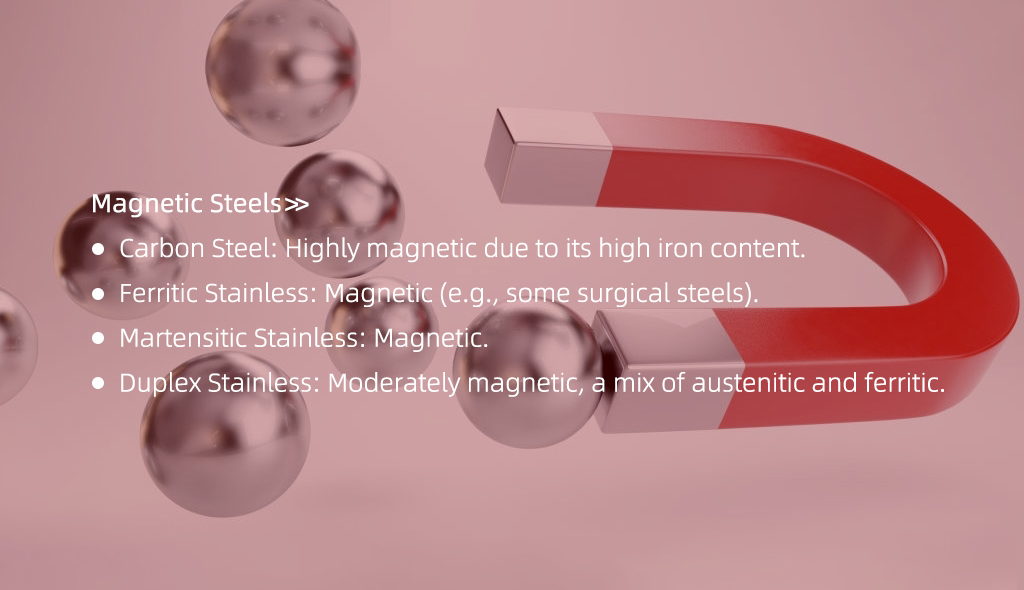
The first critical distinction in steel’s magnetic properties lies between carbon steel (also called plain carbon steel) and stainless steel. Carbon steel, which contains only iron and carbon (with trace amounts of other elements like manganese), is almost always magnetic. This is because the low carbon content (usually less than 1.5%) does not disrupt the ferromagnetic structure of iron. The carbon atoms, being much smaller than iron atoms, fit into the gaps of the iron crystal lattice without altering the alignment of magnetic domains. As a result, carbon steel readily responds to magnetic fields: it can be attracted to permanent magnets, magnetized temporarily by an electric current, or even become a permanent magnet through processes like annealing or quenching. Examples of magnetic carbon steel include construction beams, automotive parts, nails, and kitchen knives—everyday items that often stick to fridge magnets or magnetic tools.
Stainless steel, by contrast, introduces a new variable: alloying elements like chromium, nickel, and manganese. The most common type of stainless steel, austenitic stainless steel (e.g., 304 or 316 grades), is non-magnetic in its annealed (heat-treated) state. This is because the addition of nickel (typically 8-10%) stabilizes the austenitic crystal structure, which has a face-centered cubic (FCC) arrangement that does not support ferromagnetic domains. In this structure, the atomic dipoles of iron are unable to align uniformly, so the material shows no net magnetic attraction. You can test this with a kitchen spoon made of 304 stainless steel—it will not stick to a magnet. However, austenitic stainless steel can become slightly magnetic if it undergoes cold working, such as bending, stamping, or rolling. Cold working distorts the crystal structure, creating small regions of martensite (a body-centered cubic structure that is ferromagnetic). This “induced magnetism” is weak and often temporary, but it explains why some stainless steel appliances or fasteners may exhibit slight magnetic attraction.
Another category of stainless steel, ferritic stainless steel (e.g., 430 grade), is magnetic. Unlike austenitic grades, ferritic stainless steel contains high levels of chromium (11-30%) but little to no nickel. This composition stabilizes the ferrite crystal structure, which is body-centered cubic (BCC)—the same structure as pure iron. As a result, ferritic stainless steel retains iron’s ferromagnetic properties, making it strongly magnetic. It is commonly used in applications like automotive trim, kitchen sinks, and heating elements, where corrosion resistance and magnetism are both desired. Martensitic stainless steel, a third type, is also magnetic due to its BCC structure, which forms during heat treatment. This grade is known for its high strength and hardness, making it ideal for cutlery, surgical instruments, and industrial blades—all of which will attract magnets.
To deepen our understanding, we must also distinguish between ferromagnetism (permanent or strong magnetic response) and paramagnetism (weak, temporary magnetic response) in steel. Carbon steel, ferritic, and martensitic stainless steel are ferromagnetic: they can be magnetized permanently and exhibit strong attraction to magnets. Austenitic stainless steel, in its pure form, is paramagnetic: it is weakly attracted to very strong magnetic fields but does not retain magnetism once the field is removed. This difference arises from the ability of atomic dipoles to align: ferromagnetic materials have dipoles that can lock into place, while paramagnetic materials have dipoles that only align temporarily in the presence of a strong field.
The practical implications of steel’s magnetic properties are far-reaching across industries. In manufacturing, magnetic testing is used to identify steel grades: a simple magnet can quickly distinguish between austenitic (non-magnetic) and ferritic/martensitic (magnetic) stainless steel, helping quality control teams avoid material mix-ups. In construction, magnetic steel is essential for applications like reinforcing bars (rebars), which can be detected using magnetic sensors to ensure proper placement in concrete. In the automotive industry, magnetic steel is used in electric motors and generators, where its ability to retain magnetism enhances efficiency. Conversely, non-magnetic austenitic stainless steel is preferred in applications where magnetism would be a liability, such as medical equipment (to avoid interference with MRI machines) or electronic components (to prevent magnetic interference).
It’s also worth addressing common misconceptions about steel and magnetism. One myth is that “all steel is magnetic,” but as we’ve seen, austenitic stainless steel proves this false. Another myth is that magnetism in steel is a sign of poor quality, but this is irrelevant—magnetic behavior is simply a function of composition and processing. For example, a magnetic stainless steel spoon (ferritic grade 430) is not inferior to a non-magnetic one (austenitic grade 304); they are just designed for different purposes. Additionally, some people believe that rust affects steel’s magnetism, but rust (iron oxide) is actually weakly ferromagnetic. While heavy rust can reduce the magnetic attraction by separating the underlying steel, the rust itself may still be attracted to magnets.
To summarize, the answer to “Is steel magnetic?” is: it depends. Steel’s magnetic properties are determined by its composition (particularly the presence of nickel, chromium, and carbon) and its processing (heat treatment or cold working). Carbon steel is almost always magnetic, ferritic and martensitic stainless steel are magnetic, and austenitic stainless steel is non-magnetic (unless cold-worked). This variability is not a flaw but a feature, allowing engineers and manufacturers to tailor steel’s properties to specific applications—from magnetic rebars in skyscrapers to non-magnetic surgical tools in operating rooms.
In the end, steel’s magnetic behavior is a testament to the versatility of alloy design. By adjusting the ratio of elements and controlling processing conditions, scientists and engineers have created a material that can be either magnetic or non-magnetic, strong or flexible, corrosion-resistant or cost-effective. The next time you pick up a magnet and test a steel object, you’re not just checking for attraction—you’re uncovering the hidden chemistry and physics that make steel one of the most useful materials in the world.